On this page
Nasal implant removal in Korea is a different decision from choosing a new nose shape. You may want a visible or uncomfortable implant removed, have a medical concern that needs prompt assessment, or prefer to stop using synthetic material. The first useful question is what is happening now and what support will remain after removal. That answer helps determine whether the discussion concerns removal alone, removal with reconstruction, or treatment in separate stages.
You do not have to decide on a replacement material before meeting a surgeon. Bring your operation history, describe your priorities and ask for an explanation of the alternatives. If the nose has new redness, discharge, an exposed implant or worsening pain, arrange prompt medical assessment locally rather than waiting for a trip to Korea. A travel plan should follow the assessment of the problem.
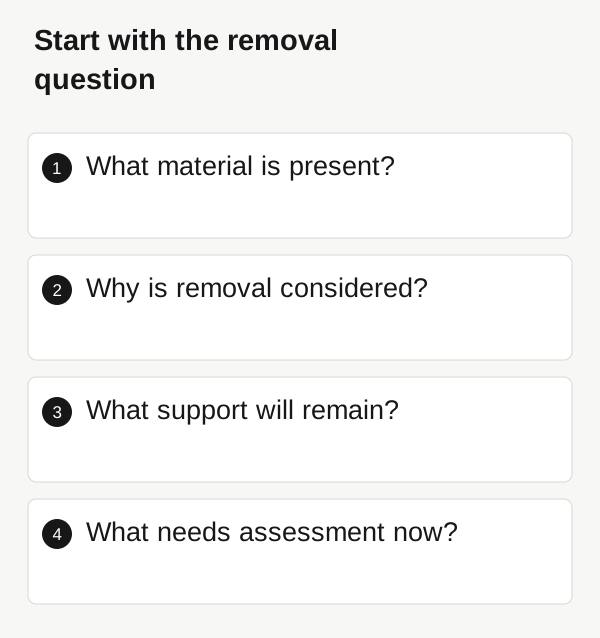
Identify the material before comparing operations
Ask the original clinic for the operation report and implant record. Useful details include the material name, the date it was placed, its position and any cartilage grafts used during the same operation. Silicone and expanded polytetrafluoroethylene, often called Gore-Tex, are different materials; a label such as “high nose surgery” does not identify either one. If you have only a bill, send a copy to the next clinic and explain what remains unknown. Do not infer the material from the bridge height or the way the nose feels.
Include procedures that you might not think of as surgery: nose filler, threads, injections to treat a scar and treatment for an earlier infection. An implanted solid device and injected filler require different discussions. If you cannot obtain an old record, write down the original clinic, approximate date and what you remember being told. The new surgeon can explain what can be established by examination and what may remain uncertain until treatment. An incomplete but honest history is more useful than an assumed material name.
Separate a stable concern from a new medical problem
A stable dislike of the bridge height leaves time for a planned discussion of choices. A new change in skin, increasing discomfort or discharge changes the immediate priority. Tell the clinician when the change started, whether it is progressing and whether you have received treatment already. Ask who should assess you now, rather than using an online revision waiting period to decide that nothing can be done yet.
Kowon's implant-removal information distinguishes stable tissues from inflammation or exposure when discussing whether reconstruction can accompany removal. This is a reason to ask about the sequence of care, not a rule you can apply to yourself. Do not press, puncture or try to reposition an implant. If symptoms are severe or rapidly worsening, seek urgent medical care where you are. Contacting a future clinic abroad can help transfer records but should not postpone an examination that is needed today.
Will removing the implant restore my original nose?
Ask the surgeon to discuss the bridge, tip and skin separately. The appearance before your first operation is a useful reference, but it is not a guaranteed preview of removal. Other changes may have been made at the original operation, and the present tissues need their own assessment. Bring earlier front, profile and oblique photographs if you have them. Request an explanation of which differences come from the implant, which involve other structures and which cannot be predicted precisely.
A published retrospective study of silicone-implant removal examined the effects of the surrounding capsule and different approaches to its treatment. It supports discussing scar tissue and the capsule during assessment; it does not establish that one technique is right for every patient or every material. Ask what the surgeon proposes to remove, what they intend to preserve and how they would respond to unexpected findings. A statement that removal will “reset” the nose needs a more specific explanation before you rely on it.
Compare removal alone, immediate reconstruction and staged care
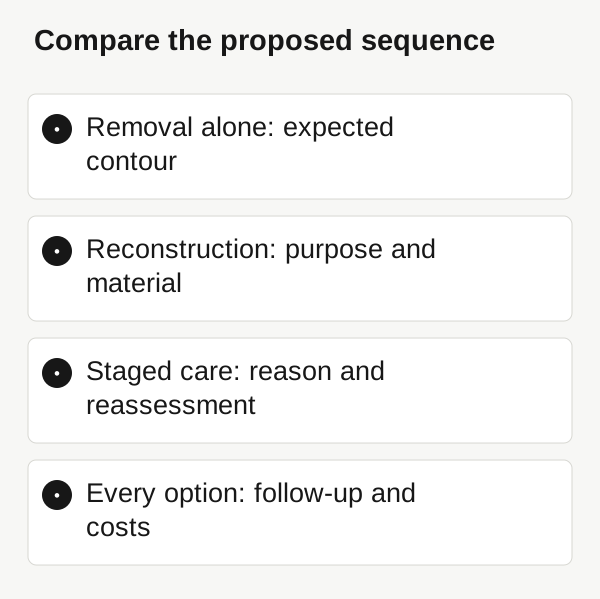
Have the surgeon describe each reasonable option in terms of the concern it addresses. For removal alone, ask about the expected contour and support afterward and the possibility of later treatment. For removal with reconstruction, ask what the additional work is intended to accomplish and why doing it at that time is suitable. For a staged plan, ask what must improve or be reassessed between the first and second procedures. These questions make different quotations easier to compare.
Do not treat a second stage as either automatic failure or automatic evidence of a safer plan. Ask for the reason in your case. Likewise, an offer to finish everything during one trip is not enough to establish suitability. Record whether the proposed reconstruction is needed for support, requested for appearance, or intended for both. If your main priority is simply to remove synthetic material, say so clearly; you should understand which additional procedures are optional before agreeing to them.
If cartilage is proposed, request a complete material plan
“Implant-free” does not tell you where tissue will come from or what the entire operation involves. Ask whether the plan uses your own septal, ear or rib cartilage, donor tissue, or a combination. Ask which role each material has and whether another synthetic product would remain. Your goal is not to design the graft yourself. It is to understand the choices you are being asked to consent to and the reasons for them.
If your own tissue would be taken from another area, include that area in the recovery conversation. Request an explanation of the incision, the important risks, the planned reviews and activity advice. Previous septal or ear surgery belongs in this discussion because the surgeon needs an accurate history. Agree in advance what alternatives are acceptable if the preferred material is unavailable or unsuitable. Ask whether a change would affect the price, the donor site or the length of your stay.
Ask about breathing as well as the bridge
Tell the clinician if breathing changed after the original operation, even when your main concern is an implant you can see. Describe the affected side, when the blockage occurs and whether it varies. Avoid concluding that removing the implant will necessarily solve the breathing problem. Ask which examination is needed and whether the functional concern requires its own treatment discussion. Keep the appearance goal and the breathing goal separate in your notes so neither disappears into a general revision quote.
If a clinic proposes several procedures together, ask for a plain explanation of how each one connects to a finding. You should be able to say which part removes material, which part addresses support or contour and which part addresses breathing. Where a concern will not be treated, ask what follow-up is appropriate. A written plan is particularly valuable if the consultation is translated, because it gives you time to check that the proposed scope matches what you understood.
Evaluate relevant photographs without expecting the same result
For implant-removal examples, ask what material was removed and whether the patient also had reconstruction. A photograph of removal with substantial grafting cannot show what removal alone would look like. Check the time between surgery and the final photograph, the views shown and whether the images use comparable lighting. Ask about the starting problem rather than focusing only on the final bridge height.
A clinic may not have permission to share a closely matched case. That does not require you to accept an unrelated example as proof. The surgeon can still discuss the reasoning and limits in your case. Keep simulations separate from photographs of actual results. Use both as conversation aids, while asking what changes cannot be represented reliably and what might remain after healing. Neither a gallery nor a simulation can promise your individual outcome.
Make the quote cover the whole sequence
Request separate line items for assessment, removal, any reconstruction, anesthesia and planned reviews. If staged care is possible, ask for the assumptions behind the estimate for each stage and which charges could change. Establish what happens to the booking deposit if an examination leads to a recommendation against the operation you originally requested. Keep written cancellation and revision terms with the quote rather than relying on a chat summary.
For travelers from the United States, compare the entire trip budget, including accommodation, a companion if needed, a changed return flight and follow-up at home. Ask your insurer directly about any proposed coverage; the words “medical” or “revision” on a clinic invoice do not establish eligibility. Currency conversion and a package discount do not resolve differences in the surgical scope. Compare like-for-like plans before using the total price to make a choice.
Plan the handover before leaving Korea
Ask for the review schedule before booking your return flight and clarify which decisions depend on how you recover. Obtain a written contact route for concerns during office hours and outside them. Find out who examines you in person if a photograph or message is not sufficient. If another stage is planned, ask who will decide when reassessment is appropriate and what records they need.
Before departure, request the final operation summary, a material inventory, medication instructions and the follow-up plan in a language you understand. If you will see a clinician in the United States, confirm that they are willing to provide the requested follow-up rather than assuming the Korean clinic can assign them that role. Keep a copy accessible to you and a trusted companion. The aim is a clear transfer of information, not a promise that every concern can be managed remotely.
A listed clinic to discuss implant removal with
Kowon Plastic Surgery
Kowon Plastic Surgery is a relevant listed option because its official revision information specifically addresses nasal implant removal and the question of reconstruction. Review its profile, then ask the clinic whether it can assess your particular material and treatment history. Bring the original operation report if it is available.
Use the consultation to clarify removal alone versus reconstruction, the reason for any stages and the follow-up you would need between them. The published service description does not establish which option is suitable for you. Ask for a written explanation of the proposed scope before making travel commitments.
Discuss implant-removal assessment with Kowon
Selection reflects its relevant published service, not a clinical quality ranking or a guarantee of outcome.
Questions patients ask
Do all nasal implants have to be replaced after removal?
The replacement decision needs an individual explanation. Ask what support and contour are expected after removal alone, whether reconstruction is necessary for the problem being treated, and which additional changes are optional. A preference to avoid another synthetic implant is important information to share.
Can I choose implant removal from an online consultation?
An online discussion can clarify your history, goals and the records to bring. It cannot settle every question about the tissues or the final surgical scope. Ask which parts of an estimate remain provisional until an examination and avoid treating a booked date as proof of suitability.
Should I wait until I can travel if the implant becomes exposed?
No. An exposed implant or new signs of a problem need prompt local medical assessment. Send relevant records to the treating clinician. A future appointment in Korea should not become a reason to postpone care for a current concern.